Hora de leer
2 minutes
Diffusion of Innovations
The Diffusion of Innovations model is based on the process of understanding how new ideas and products spread - and why some very good ones don't make it or take a long time to catch on.
Approximate year of origin:
Early 1900's: Gabriel Tarde, beginning of his diffusion observations.
1920's: The beginning of anthropological research tradition in diffusion.
1960's: An explosion of diffusion investigations in Latin America, Africa, and Asia began.
Diffusion of Innovations is a theory that analyses, as well as helps explain, the adaptation of a new innovation. In other words, it helps to explain the process of social change. An innovation is an idea, practice, or object that is perceived as new by an individual or other unit of adoption. The perceived newness of the idea for the individual determines his/her reaction to it (Rogers, 1995). In addition, diffusion is the process by which an innovation is communicated through certain channels over time among the members of a social system. Thus, the four main elements of the theory are the innovation, communication channels, time, and the social system.
Important issues the change agent should consider:
The change agent or person introducing the innovation in a social system should take into consideration the following aspects: the characteristics of the target population (the adopter categories), the characteristics of the innovation or change itself, and the stages of adoption. Each of these three categories should be analysed and planned for, when introducing an innovation or change.
A graphical explanation of the rate of diffusion:
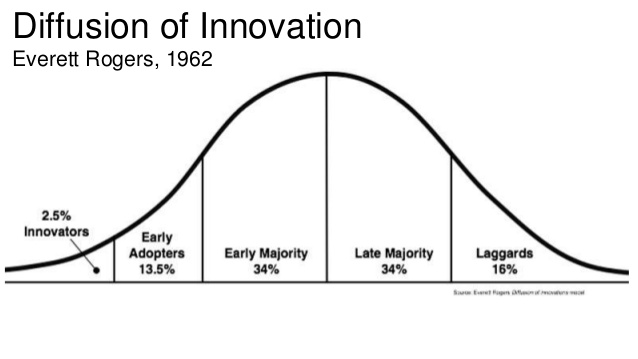
The new idea or innovation typically moves slowly through a societal group as it is first introduced. Then, as the number of individuals trying the innovation (the adopters) increases, the diffusion of the new idea moves at a faster rate. The diffusion phenomenon initially follows an S-shaped curve. The curve shows the slow rate of adoption of an innovation by the adopters at an early stage. The diffusion curve increases as the number of adopters also increases. Then, after the possible new adopters naturally decrease, so does the diffusion curve. Hence, the total diffusion of an innovation would follow in reality a Normal curve. The diffusion is determined then by the social group, and each social group of adopters can be designated in the curve.
Diffusion: The process by which an innovation is communicated through certain channels over time among the members of a social system.
Innovation: An idea, practice, or object that is perceived as new by an individual or other unit of adoption.
Note - this model was detailed in the 1962 publication "Diffusion of Innovations" by Everett M. Rogers, which is in its 5th edition as of July 19 2017.
Approximate year of origin:
Early 1900's: Gabriel Tarde, beginning of his diffusion observations.
1920's: The beginning of anthropological research tradition in diffusion.
1960's: An explosion of diffusion investigations in Latin America, Africa, and Asia began.
Diffusion of Innovations is a theory that analyses, as well as helps explain, the adaptation of a new innovation. In other words, it helps to explain the process of social change. An innovation is an idea, practice, or object that is perceived as new by an individual or other unit of adoption. The perceived newness of the idea for the individual determines his/her reaction to it (Rogers, 1995). In addition, diffusion is the process by which an innovation is communicated through certain channels over time among the members of a social system. Thus, the four main elements of the theory are the innovation, communication channels, time, and the social system.
Important issues the change agent should consider:
The change agent or person introducing the innovation in a social system should take into consideration the following aspects: the characteristics of the target population (the adopter categories), the characteristics of the innovation or change itself, and the stages of adoption. Each of these three categories should be analysed and planned for, when introducing an innovation or change.
A graphical explanation of the rate of diffusion:
The new idea or innovation typically moves slowly through a societal group as it is first introduced. Then, as the number of individuals trying the innovation (the adopters) increases, the diffusion of the new idea moves at a faster rate. The diffusion phenomenon initially follows an S-shaped curve. The curve shows the slow rate of adoption of an innovation by the adopters at an early stage. The diffusion curve increases as the number of adopters also increases. Then, after the possible new adopters naturally decrease, so does the diffusion curve. Hence, the total diffusion of an innovation would follow in reality a Normal curve. The diffusion is determined then by the social group, and each social group of adopters can be designated in the curve.
Diffusion: The process by which an innovation is communicated through certain channels over time among the members of a social system.
Innovation: An idea, practice, or object that is perceived as new by an individual or other unit of adoption.
Note - this model was detailed in the 1962 publication "Diffusion of Innovations" by Everett M. Rogers, which is in its 5th edition as of July 19 2017.
Comments

- Inicie sesión para enviar comentarios